Water Damage Restoration Guide for Dunwoody, GA
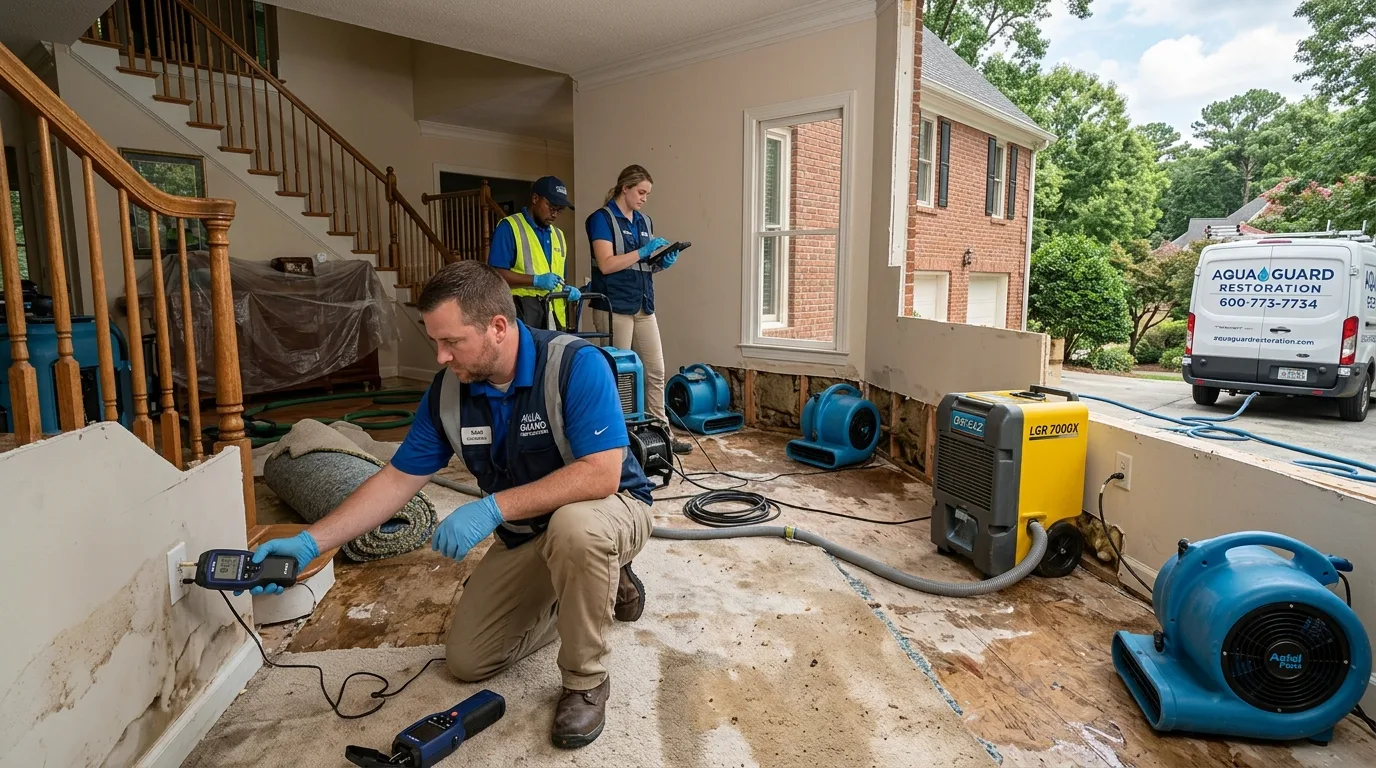
When water floods a Dunwoody home — whether from a burst pipe in a Dunwoody Club Forest brick house or a summer storm overwhelming a Village Mill drainage system — the decisions made in the first two hours determine whether the damage is contained or catastrophic. In this guide, we cover the complete water damage restoration process for Dunwoody homeowners: what to do immediately, how local climate and soil conditions affect restoration, how long the process takes, what it costs, and how to navigate an insurance claim.
Water Damage in Dunwoody? Call 24/7
Dunwoody Water Damage Restoration responds immediately. IICRC certified, works with all insurance. Call (877) 698-1311.
Why Water Damage Restoration Matters for Dunwoody Homeowners
The consequences of delayed or incomplete water damage restoration in Dunwoody, GA are more severe than in many other markets, and the reasons are rooted in the local environment. Dunwoody’s summer dew points regularly reach the low-to-mid 70s — one of the highest ambient humidity levels in the continental United States. This means that even after visible water is extracted, the surrounding air contains enough moisture to re-wet drying materials and support mold colonization within 24–48 hours if dehumidification is not actively running.
The 22-acre Dunwoody Nature Center sits in the heart of a community where tree canopy and adjacent waterways keep microclimate humidity elevated even on nominally clear days. Homeowners throughout the Wynterhall neighborhood — where wooded lots are the norm — find that their properties hold humidity longer than open-lot developments, requiring extended drying timelines. Proper water damage restoration in Dunwoody means accounting for these conditions from the first hour, not discovering them after the first moisture reading reveals materials are still wet on day four.
DeKalb County’s population density and older municipal infrastructure create an additional risk: sewer system stress during peak storm events can push Category 3 sewage water into residential drain lines at the same time storm water is entering from above. Understanding this dual-risk dynamic during summer storm events is part of what makes local expertise in Dunwoody restoration essential.
Types of Water Damage in Dunwoody
Category 1 (Clean Water): Originates from a sanitary source — supply lines, water heaters, ice makers. The lowest health risk, but still capable of causing significant structural damage if not extracted immediately. Common sources in Dunwoody: CPVC supply line failures (prevalent in 1985–2005 homes), water heater failures, refrigerator ice maker lines.
Category 2 (Gray Water): Contains contaminants that can cause illness if ingested. Common sources: washing machine overflow, dishwasher discharge, toilet overflow without feces, storm water entry. Most Dunwoody storm flooding events are Category 2 due to lawn chemicals and soil bacteria in runoff.
Category 3 (Black Water): Contains sewage or other highly contaminated water — serious health hazard requiring full PPE and specialized protocols. Sources: sewer backup, flood water with sewage, toilet overflow with feces. Requires removal of all porous materials that contacted the water, not just drying.
The Water Damage Restoration Process
Step 1 — Emergency response and initial assessment (Hours 0–2): A technician arrives, shuts off any active water source if still running, and performs a rapid moisture mapping assessment using thermal imaging and pin/pinless meters. All affected rooms, materials, and structures are identified — including hidden moisture behind drywall and under flooring that is not visually apparent.
Step 2 — Water extraction (Hours 2–6): Truck-mounted or high-capacity portable extractors remove standing water from floors, carpet, and subflooring. The speed and completeness of extraction directly determines how much structural material can be dried in place vs. must be removed and replaced. For basement flooding in Dunwoody neighborhoods, extraction must address hydrostatic conditions — water continuing to enter from saturated clay soil outside.
Step 3 — Controlled demolition if needed (Hours 4–24): Materials that cannot be dried to standard — wet drywall below the flood line, saturated insulation, carpet and pad in Category 2 or 3 events — are removed. This is not damage to the home; it is the protective action that prevents mold from growing inside enclosed wall cavities.
Step 4 — Structural drying (Days 1–7): Commercial dehumidifiers and air movers are placed in calculated configurations to create the vapor pressure differential needed to draw moisture out of structural materials. In Dunwoody, LGR dehumidifiers handle above-grade spaces effectively in warm months; desiccant dehumidifiers are required for basement concrete block walls. Daily moisture readings track every affected material toward its dry standard.
Step 5 — Antimicrobial treatment: EPA-registered antimicrobial agents are applied to all affected structural surfaces to suppress mold colonization during the drying phase. This is standard practice, not optional — in Dunwoody’s climate, untreated surfaces colonize even under running dehumidification.
Step 6 — Reconstruction (Days 7–21+): After all materials are verified dry using calibrated moisture meters, reconstruction begins — replacing drywall, insulation, flooring, trim, and any other removed materials. Permits from Dunwoody’s Community Development Department are pulled for any structural, plumbing, or electrical work per Georgia law O.C.G.A. 43-14.
Step 7 — Final documentation: Complete moisture logs, before/after photos, scope of work documents, and certificates of completion are provided for your insurance file.
IICRC-Certified Restoration in Dunwoody
Every step documented for your insurance claim. Call Dunwoody Water Damage Restoration at (877) 698-1311.
How Long Water Damage Restoration Takes in Dunwoody
For a typical above-grade water damage event (burst pipe, appliance failure), expect:
- Extraction: 2–6 hours on day one
- Structural drying phase: 3–5 days
- Reconstruction: 1–2 weeks depending on scope
Basement flooding in Dunwoody takes longer. DeKalb County’s Piedmont red clay soil continues exerting hydrostatic pressure against foundation walls for 3–7 days after a storm event, reloading materials that are being dried from inside. Expect a 5–10 day drying phase for basement jobs, with daily monitoring to track progress.
What Water Damage Restoration Costs in Dunwoody
Water damage restoration in the Atlanta metro area averages $8,546, with a range of $1,874 to $15,960. Per square foot: clean water approximately $7.77, gray water $11.66, black water $16.65. Labor runs $155–$444 per hour depending on specialty.
The variables that drive cost in Dunwoody specifically: larger homes in neighborhoods like Heritage at Dunwoody ($1M–$1.8M) or Hidden Branches ($635K–$1.5M) have more square footage to affect, and premium finishes cost more to replace. Basement drying jobs cost more due to extended drying timelines and the frequency of waterproofing additions needed to prevent recurrence.
Insurance Claims for Water Damage in Dunwoody
Standard homeowner’s insurance covers sudden and accidental water damage — burst pipes, appliance failures, roof leaks from storm damage. It typically does NOT cover flooding from external rising water (requires separate NFIP flood insurance) or gradual leaks that were not promptly reported.
For covered events, the documentation process matters enormously. Provide your carrier with: date/time of discovery, cause of loss (as specific as possible), photos taken before any cleanup, and the restoration company’s scope of work and moisture logs. We provide all documentation in the format insurance carriers require and communicate directly with your adjuster.
Frequently Asked Questions
How quickly does mold grow after water damage in Dunwoody?
In Dunwoody’s climate, mold begins colonizing within 24–48 hours of water intrusion on materials that remain wet. During summer months when dew points are in the 70s, this timeline can compress to under 24 hours in inadequately ventilated spaces. This is why the 24-hour clock begins the moment you discover water — not the moment you call a restoration company. Act immediately. See our related guide on mold after water damage in Dunwoody homes for more detail.
What should I do before the restoration crew arrives?
Shut off the water source if still active. Take photos and video of all affected areas — this documentation is critical for your insurance claim. Move valuables, electronics, and important documents away from wet areas if it is safe to do so (watch for electrical hazards). Do not use a household vacuum to attempt water removal. Do not run fans without also running a dehumidifier — in Dunwoody’s humidity, fans without dehumidification can spread moisture to unaffected materials.
Does water damage restoration require permits in Dunwoody?
The extraction and drying phases do not require permits. Reconstruction work — replacing drywall, flooring, plumbing components, or electrical systems — requires permits from the Community Development Department. Water heater replacements specifically require plumbing and gas permits. Read our full Dunwoody permit guide for water damage repairs.
Start Recovery Today — Call (877) 698-1311
Dunwoody Water Damage Restoration — 24/7 emergency response, IICRC certified, full insurance documentation.
Related resources: