5 Signs of Hidden Water Damage in Dunwoody Homes
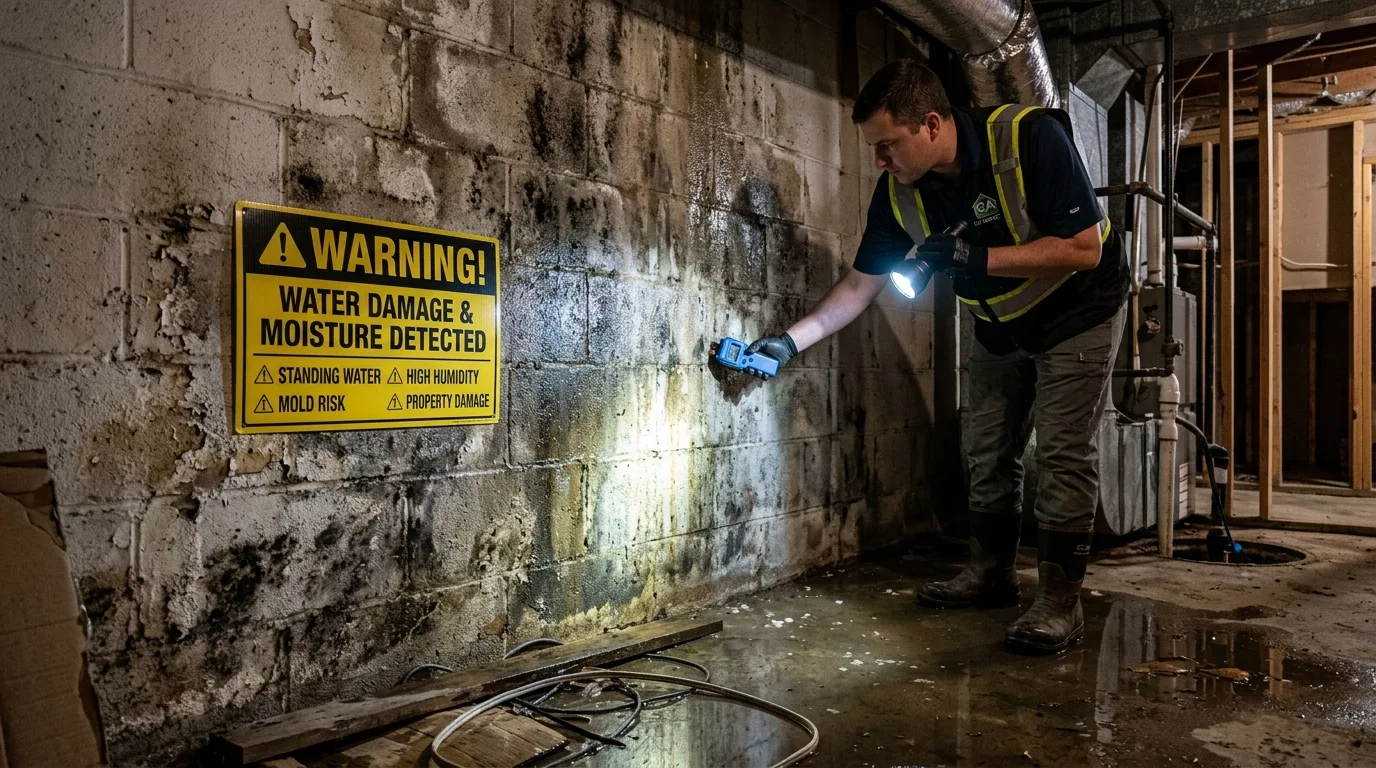
By the time water damage becomes visible in a Dunwoody home, it has usually been present and growing for weeks, months, or even years. Hidden water damage — moisture accumulating inside walls, under flooring, and in crawl spaces without obvious surface evidence — is endemic in Dunwoody’s housing stock, particularly in the 1970s-era brick homes of Dunwoody Club Forest and the 1985–2005 CPVC-era construction throughout the broader community. In this post, we identify the five most important warning signs Dunwoody homeowners should watch for — signs that indicate water damage is happening inside your walls before a small problem becomes a structural one.
Suspect Hidden Water Damage in Your Dunwoody Home?
Thermal imaging reveals what eyes cannot. Call Dunwoody Water Damage Restoration at (877) 698-1311 for a professional assessment.
Why Hidden Water Damage Is Especially Common in Dunwoody
Dunwoody’s climate creates conditions where water damage can grow slowly and silently for an extended period before triggering any obvious alarm. Summer dew points in the 70s mean that crawl spaces and wall cavities are operating at or near the dew point temperature for months at a time — creating persistent condensation on structural surfaces even without any plumbing failure. Homes throughout Hidden Branches, with their wooded lots and naturally higher microclimate humidity, experience this chronic moisture loading more acutely than open-lot properties.
The 1985–2005 housing stock presents a specific hidden water damage vector: CPVC fittings that become brittle with age and thermal cycling. A CPVC supply line fitting behind a wall may develop a pinhole leak that drips slowly for months — enough to saturate insulation and begin mold colonization without ever causing a puddle on the floor. By the time the homeowner notices a musty smell or a soft spot in drywall, significant structural saturation has already occurred.
Sign 1: Persistent Musty or Earthy Odor
A musty or earthy smell that doesn’t go away with ventilation or cleaning is one of the most reliable early indicators of hidden water damage and mold growth in a Dunwoody home. Mold produces volatile organic compounds (MVOCs) as metabolic byproducts — these compounds have the characteristic musty smell that many homeowners associate with old basements or damp closets.
If the smell is concentrated in a particular room, corner, or closet — rather than throughout the home — it points to a localized moisture source. Common locations for this pattern in Dunwoody homes: under kitchen sinks (supply line or drain fitting leak), in bathrooms adjacent to exterior walls (shower pan or supply line leak), in laundry rooms (washing machine supply line or drain overflow), and in finished basements in Dunwoody Club Forest and similar neighborhoods where foundation moisture is chronic. The smell indicates active mold colonization inside structural materials — not just surface mildew that surface cleaning will address.
Musty Smell in Your Dunwoody Home?
Don't wait for visible mold — call for an assessment at the first sign. (877) 698-1311.
Sign 2: Staining, Discoloration, or Warping on Walls and Ceilings
Water staining presents as yellow, brown, or gray discoloration — often with a distinct ring pattern where water dried repeatedly at the edges of a wet area. On Dunwoody homes with drywall ceilings (the majority of post-1980s construction), ceiling stains almost always indicate a plumbing or roof leak above. On the older plaster construction found in some Dunwoody Village-area homes, staining may be older but can still indicate an active chronic moisture problem.
Warping or bubbling of drywall surfaces without visible staining indicates moisture inside the wall cavity that has elevated the drywall’s moisture content above its structural limit. This pattern often appears first at the base of walls — where water that has traveled down a wall cavity encounters the floor plate and accumulates. Baseboards that are separating from walls or showing curvature at their ends are a related indicator of floor-level moisture accumulation.
Sign 3: Buckling, Soft, or Discolored Flooring
Hardwood floors that are cupping (edges curving upward), buckling at seams, or showing individual boards that have expanded and separated from their neighbors have experienced moisture infiltration from either below (subfloor moisture) or above (repeated surface wetting). In Dunwoody homes throughout neighborhoods like Brooke Farm and Wynterhall, hardwood floors in ground-level rooms are vulnerable to subfloor moisture that wicks up from crawl spaces during the humid summer months.
Soft spots in flooring — areas where the floor gives slightly underfoot — indicate that the subfloor OSB or plywood has experienced elevated moisture content and has begun to delaminate or lose structural integrity. This condition is common under bathroom fixtures with slow leak drain fittings and in areas adjacent to dishwashers and under-sink spaces. Finding a soft spot in flooring is a reliable indicator that water damage has been present for weeks to months and requires investigation before structural deterioration progresses further.
Sign 4: Peeling Paint, Efflorescence, or Rust on Walls
Paint or wallpaper peeling away from walls — particularly on exterior-facing walls or in bathrooms — indicates that moisture is migrating through the wall material from inside. Interior walls that are consistently damp to the touch even in dry weather indicate a supply line or drain line leak inside the wall cavity.
Efflorescence — the white or gray powdery deposits that appear on concrete or masonry surfaces — is caused by water carrying dissolved minerals through the masonry and depositing them on the surface as it evaporates. In Dunwoody basement walls (especially in older Dunwoody Club Forest concrete block construction), efflorescence is a direct indicator of water migration through the foundation wall from the surrounding clay soil. This is not cosmetic — it’s evidence of ongoing hydrostatic pressure and water movement through structural masonry. Similarly, rust stains on concrete surfaces indicate that embedded metal reinforcement has been in contact with water long enough to oxidize.
Sign 5: Unexpectedly High Water Bills or Running Meters
A water bill that is consistently higher than expected without a change in household usage, or a water meter that runs when all fixtures are off, indicates an active water leak somewhere in the plumbing system. In Dunwoody, the most common hidden sources are: supply lines under slabs (slab leaks), supply lines inside walls, toilet fill valves that run continuously, and irrigation system failures.
A simple meter test: turn off all water fixtures and check the meter. If it is still moving, there is an active leak somewhere in the supply system. The location of the leak determines whether it is causing hidden structural water damage — a supply leak under a slab, inside a wall, or in a crawl space may not be causing any visible symptoms while saturating structural materials for months.
Frequently Asked Questions
How is hidden water damage detected professionally?
Thermal imaging cameras detect temperature differentials between dry and wet building materials — wet areas appear as distinct temperature anomalies on the thermal image. Pin-type moisture meters provide quantitative moisture content readings in wood and drywall materials. Pinless (non-destructive) meters allow broader scanning of large surface areas without drilling test holes. Professional inspection combines thermal imaging, moisture meter readings, and physical inspection of accessible spaces (crawl spaces, attic, under sinks) to build a comprehensive moisture map of the property. For more, see our complete water damage restoration guide for Dunwoody.
Can I address hidden water damage myself?
Minor surface mold that has not penetrated behind drywall can sometimes be addressed by a competent DIY approach. However, any water damage that has penetrated behind wall surfaces, under flooring, or into structural materials requires professional assessment and remediation. In Dunwoody’s humidity, hidden water damage rarely self-resolves — it accumulates. The cost of professional assessment (typically free from restoration companies) is far less than the cost of discovering three months later that mold has colonized inside wall cavities. See our mold after water damage guide for what’s at stake.
How does hidden water damage affect a Dunwoody home’s value?
In Dunwoody’s high-value housing market — where homes in neighborhoods like Heritage at Dunwoody regularly transact at $1M+ — undisclosed or unresolved hidden water damage is one of the highest-risk defects a seller can face. Home inspectors in this market are thorough, and buyers’ attorneys are experienced with water damage claims. Properly documented, professionally remediated water damage that has been disclosed and repaired is substantially less of a transaction obstacle than undisclosed moisture problems discovered during inspection. See our insurance claim guide for DeKalb County for documentation strategies.
Find Hidden Water Damage Before It Finds You
Thermal imaging, moisture mapping, free assessment. Call Dunwoody Water Damage Restoration at (877) 698-1311.
Related resources: