Red Clay Soil and Water Damage in Dunwoody, GA
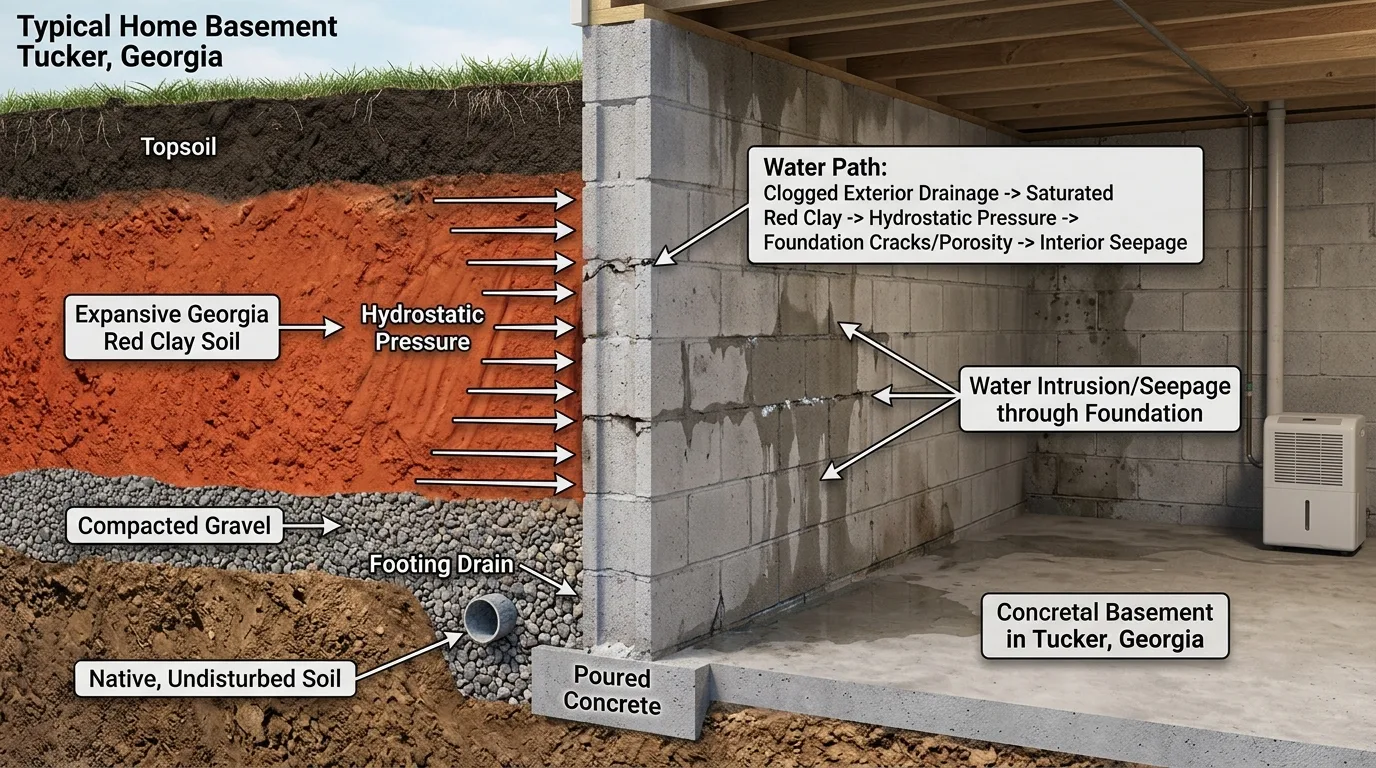
Dunwoody homeowners spend more on water damage restoration than residents of comparable Georgia markets — and the reason is underground. DeKalb County sits atop the Piedmont red clay plateau, a geological formation with one of the lowest water permeability ratings found anywhere in the Atlanta metro. When heavy rain falls on Dunwoody, it doesn’t drain away in hours the way it does in coastal Georgia’s sandy soils. It holds. In this post, we cover what the red clay factor means for water damage outcomes, drying timelines, foundation pressure, and restoration costs in Dunwoody, GA.
Wet Basement or Foundation Moisture in Dunwoody?
We understand DeKalb County's red clay conditions — and we design restoration jobs to account for them. Call (877) 698-1311.
Why Dunwoody’s Soil Matters for Water Damage
The soil beneath a property isn’t just the medium that holds plants — it’s the drainage infrastructure for everything that happens above it. In sandy coastal soils, rainwater percolates down through several feet of permeable material, moving away from foundations and into the water table relatively quickly. In Dunwoody’s Piedmont red clay, water essentially pools in place: the clay’s molecular structure bonds tightly with water molecules and releases them slowly, over days rather than hours.
The practical consequence for Dunwoody homeowners is that after any significant rainfall event, the soil surrounding their foundations becomes fully saturated and stays that way. This saturation creates hydrostatic pressure — the weight and force of water held in soil pressing against whatever structure is adjacent to it. For homes in neighborhoods like Dunwoody Club Forest (built in the 1970s on lots that predate modern stormwater management) and the Mill Glen community (where pond-adjacent lots have chronic groundwater elevation), this pressure is not an occasional event — it is the baseline condition for a significant portion of the year.
The Hydrostatic Pressure Problem
Hydrostatic pressure is the primary mechanism by which DeKalb County’s red clay turns rainfall events into foundation and basement water damage. As clay soils become saturated, they exert pressure in all directions — including against basement walls, foundation footings, and slab edges. Concrete is porous; given enough sustained pressure, water works through the concrete matrix itself, not just through cracks or gaps. This is why Dunwoody basement walls often show a “weeping” pattern of moisture across their entire surface after heavy rain, not just at visible cracks.
The challenge this creates for water damage restoration is twofold. First, the water intrusion doesn’t stop when the rain stops — it continues as long as the surrounding soil remains saturated, which in Dunwoody clay can mean 3–7 days after the last rainfall. A basement that is extracted and dried on Monday can be wet again by Thursday if exterior drainage and waterproofing are not addressed. Second, the density of wet concrete block basement walls — common throughout Dunwoody’s older housing stock — requires desiccant dehumidifiers rather than standard LGR units to draw moisture from the masonry material effectively.
Foundation Water Damage — Dunwoody Specialists
We diagnose the moisture source before recommending restoration, not after. Call (877) 698-1311 for a free assessment.
How Red Clay Extends Drying Timelines
Standard water damage restoration benchmarks assume the exterior soil condition is stable — that after extraction, drying equipment can drive moisture out of structural materials without continued exterior pressure refilling them. In sandy-soil markets, this assumption holds. In Dunwoody’s red clay environment, it often doesn’t.
By early spring, Dunwoody homeowners in areas like Hidden Branches and Wynterhall discover that their soil moisture level has been elevated continuously since fall — DeKalb County’s cumulative 52+ inches of annual rainfall keeps clay soils at or near saturation for months at a time. Restoration jobs starting from this elevated soil moisture baseline take 25–40% longer to complete than benchmark timelines suggest. Restoration companies using standard drying timelines developed in other markets will declare a Dunwoody basement “dry” before the job is actually complete.
Proper restoration in red clay conditions requires daily moisture readings with calibrated meters at multiple depths within the concrete block or poured foundation wall, not just surface readings. It also requires confirmation that the exterior soil condition is improving — monitoring the progression from saturated to merely moist to dry — before final clearance can be given.
Practical Implications for Dunwoody Property Owners
Expect longer timelines: Dunwoody basement and foundation water damage jobs take 5–10 days for structural drying rather than the 3–5 day benchmark typical of above-grade or sandy-soil jobs. Plan for extended equipment placement.
Extraction alone is not restoration: In red clay conditions, removing visible water from a basement does not solve the problem — it addresses the symptom. The external hydrostatic pressure will generate more water until the soil dries. True restoration includes drainage solutions.
Waterproofing matters more here: Interior French drain systems, sump pump installations, and exterior drainage improvements provide far greater long-term protection in DeKalb County’s clay soil environment than in markets where gravity drainage naturally moves water away from structures. These are not optional upgrades in Dunwoody — they are the difference between a one-time restoration job and an annual repair cycle.
Peer comparisons don’t apply: Dunwoody homeowners should not compare restoration outcomes to friends in Sandy Springs (which has more varied soil profiles) or Chamblee (which has different drainage infrastructure). The red clay factor is specific to Dunwoody and the Piedmont plateau portion of DeKalb County.
Cost Implications in Dunwoody
Water damage restoration in the Atlanta metro area averages $8,546 with a range of $1,874–$15,960. Dunwoody basement and foundation jobs consistently trend toward the upper range due to: extended drying timelines requiring more equipment-days, the frequency of waterproofing additions (interior French drains at $4,000–$12,000, sump pump installation at $500–$3,000), and the cost of replacing finished basement materials in high-value Dunwoody homes.
Understanding the red clay factor explains why a “quick” basement cleanup that skips waterproofing assessment is not a bargain — it’s a setup for the next water damage event, which arrives with every significant rainfall. A thorough restoration that includes drainage solutions costs more upfront but prevents the compounding cost of repeated events.
Frequently Asked Questions
Does every Dunwoody home have red clay foundation problems?
Not every Dunwoody home experiences active water intrusion, but all Dunwoody properties sit on the same Piedmont clay geology. Homes with good original drainage design, maintained gutters and downspouts, positive lot grading away from the foundation, and functioning sump pumps may never experience a water intrusion event despite the clay conditions. The risk is present for every Dunwoody property — management determines whether it becomes a problem. Learn more about basement water damage in Dunwoody.
What’s the difference between surface drainage and hydrostatic pressure?
Surface drainage problems — water pooling at the foundation because gutters overflow or downspouts discharge at the foundation — are relatively simple to address with grading corrections and downspout extensions. Hydrostatic pressure from saturated clay soil is a more fundamental problem that requires waterproofing of the foundation wall itself, not just redirection of surface water. Many Dunwoody basement water problems involve both components, and both must be addressed for a lasting fix. See our guide to water damage restoration in Dunwoody for a full framework.
Are Dunwoody homes with slab foundations affected differently?
Slab-on-grade construction — common in Dunwoody’s 1985–2005 housing boom — is less susceptible to basement flooding but is not immune to the red clay problem. Saturated clay beneath slabs can cause slab lifting, cracking, and moisture wicking up through the concrete. Dunwoody homes with unexplained floor dampness or elevated indoor humidity on ground floors should have their slab moisture assessed.
Red Clay Basement Problems? We Know Dunwoody.
Call Dunwoody Water Damage Restoration at (877) 698-1311. We address the geology, not just the visible water.
Related resources: