Basement Water Damage in Dunwoody, GA: Causes & Solutions
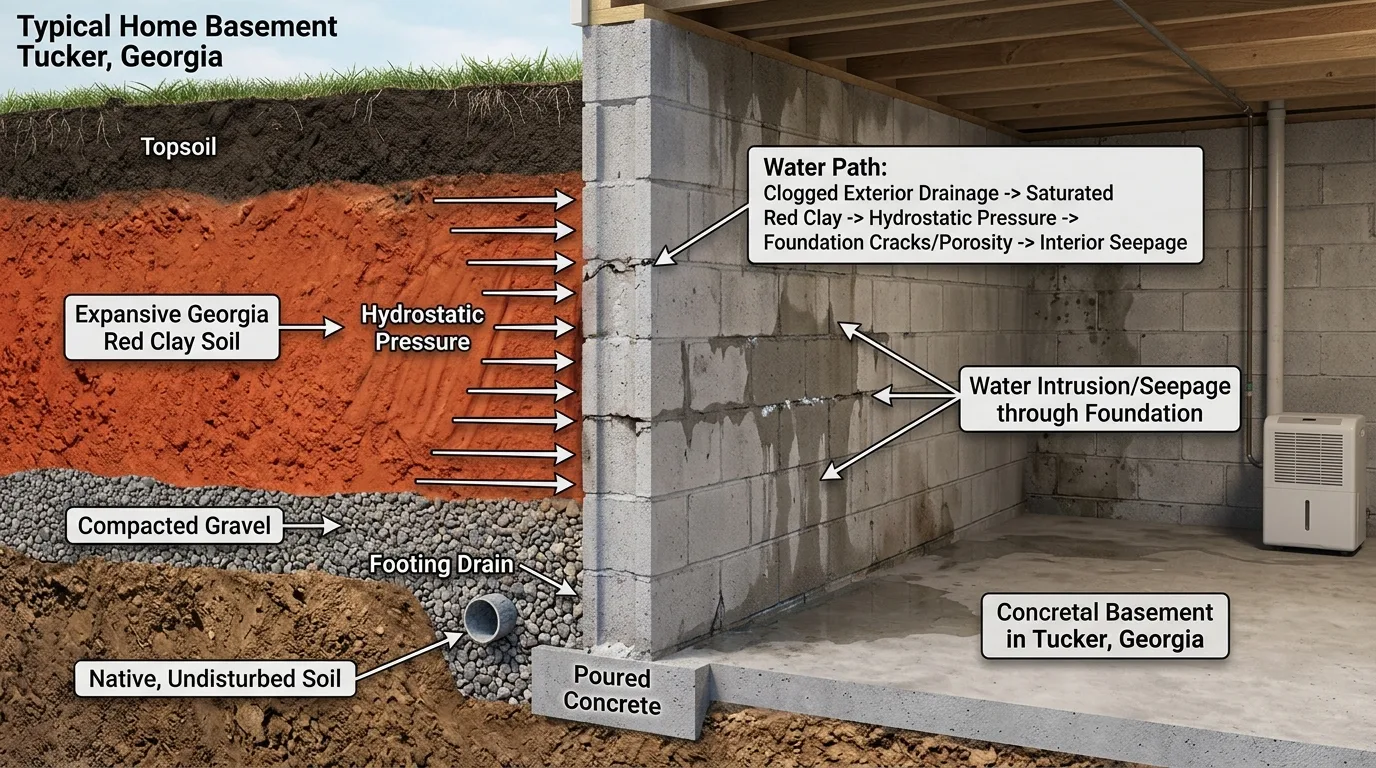
The most common call we receive in Dunwoody after a summer thunderstorm is about a wet basement. Homeowners in neighborhoods across Dunwoody Club Forest, Meadowlake, and Mill Glen find water at the base of their foundation walls, pooling in corners, or streaming through wall cracks — and many have the same question: why does this keep happening? The answer lies in the specific interaction between Dunwoody’s rainfall patterns, DeKalb County’s red clay soil, and the construction era of their homes. In this guide, we explain the causes of basement flooding in Dunwoody and what effective, lasting solutions look like.
Wet Basement in Dunwoody?
Free assessment — we diagnose the cause, not just the symptom. Call Dunwoody Water Damage Restoration at (877) 698-1311.
Why Dunwoody Basements Flood
Cause 1: Hydrostatic Pressure from Red Clay Saturation
The most fundamental cause of basement flooding in Dunwoody is the Piedmont red clay that underlies all of DeKalb County. When Dunwoody’s summer storms deliver 1–3 inches of rain in an hour, the clay becomes fully saturated within the first 15–30 minutes — it simply cannot absorb water fast enough. From that point, additional rainfall becomes surface runoff that flows toward the lowest point: your basement walls and window wells.
The saturated clay then holds that water against your foundation walls with sustained hydrostatic pressure for 3–7 days after the rain stops. During that period, water migrates through the concrete matrix of foundation walls — not just through cracks, but through the porous concrete itself. Homes throughout Dunwoody Club Forest, where 1970s construction predates modern drainage standards and where lots have mature trees with root systems that have disturbed drainage grading, experience this phenomenon repeatedly each storm season.
Cause 2: Inadequate or Failed Drainage Systems
Many Dunwoody homes built in the 1970s and 1980s relied on perimeter drainage tile (clay or plastic drain tile around the foundation footing) that was adequate when installed but has since been compromised by root infiltration, silting, or simple age. When this perimeter drainage fails, there is no path for groundwater to move away from the foundation — hydrostatic pressure builds until it finds the path of least resistance into the basement.
More recent construction in Dunwoody typically included sump pits, but the sump pump itself is a mechanical component with a finite service life. A sump pump that fails during a power outage — which is precisely when it is most needed, during a summer storm — converts a protected basement into a flooded one within hours.
Cause 3: Surface Drainage Failures
Gutter downspouts that discharge at the foundation, lot grading that slopes toward the house rather than away, and window wells that have lost their gravel drainage fill are surface drainage failures that direct water toward the foundation before it even reaches the soil permeability question. These are the easiest problems to identify and the cheapest to correct — and they are present in a majority of the wet basement calls we respond to in Dunwoody.
Basement Flooding Assessment in Dunwoody
We identify every moisture pathway, not just the one causing the current event. Call (877) 698-1311.
Practical Approaches to Basement Water Damage in Dunwoody
Interior French drain systems: An interior perimeter drainage system — typically a 4-inch slotted pipe installed at the footing of the basement wall, draining to a sump pit — intercepts water that migrates through the wall before it can accumulate on the basement floor. This approach works with the hydrostatic pressure rather than against it: instead of trying to stop water from entering the wall (which requires exterior excavation and waterproofing), it provides a controlled path for water to drain before it floods the space. Interior French drain systems in Dunwoody homes typically cost $5,000–$12,000 depending on basement perimeter length.
Sump pump installation or replacement: A properly sized sump pump — including a battery backup unit for power outage events during storms — is the mechanical heart of a functional basement drainage system. In Dunwoody’s storm environment, a sump system without battery backup is only half a solution. Sump pump installation costs $500–$2,500; battery backup systems add $500–$1,500.
Exterior drainage correction: Downspout extensions that direct discharge 6+ feet from the foundation, regrading of soil away from the foundation, and window well drainage restoration are surface-level corrections that reduce the volume of water reaching the foundation in the first place. These are the first interventions to make because they reduce the load on the waterproofing system.
Foundation crack injection: Specific cracks in poured concrete basement walls — not concrete block, which requires different approaches — can be permanently sealed with polyurethane or epoxy injection that expands to fill the crack completely. This is appropriate for isolated structural cracks, not for walls that are experiencing general moisture migration through the concrete matrix.
What to Do After a Basement Floods
First, if there is any possibility of sewage involvement (floor drain backup, toilet overflow) — do not enter the space without appropriate PPE. Category 3 black water requires professional response.
For clean water basement flooding, shut off any power to the affected area if electrical components may be in contact with water. Document the damage with photos before any extraction or cleanup begins. Call a restoration professional immediately — in Dunwoody’s climate, the 24-hour mold clock begins when the basement floods, not when the water stops entering.
Do not attempt to dry a Dunwoody basement with a shop vac and household fans. The combination of below-grade concrete surfaces, ongoing soil moisture infiltration from saturated red clay, and Georgia’s ambient humidity levels requires commercial dehumidification equipment specifically configured for below-grade environments. Standard residential fans without dehumidification actually make the problem worse by spreading moisture to additional materials.
Cost Expectations for Dunwoody Basement Water Damage
Water damage restoration in the Atlanta metro averages $8,546, with basement jobs commonly in the $8,000–$20,000 range when finished living space is involved and waterproofing additions are included. The key cost components:
- Emergency extraction and drying: $2,000–$8,000 depending on volume and duration
- Finished basement material replacement (drywall, flooring, trim): $3,000–$15,000 depending on scope and finishes
- Interior French drain system: $5,000–$12,000
- Sump pump with battery backup: $1,000–$4,000
In DeKalb County, Dunwoody’s higher property values mean finished basement restoration costs more per square foot than comparable jobs in Chamblee or Tucker — premium flooring, built-in cabinetry, and media equipment are common in Dunwoody’s finished basement market. Understanding the full cost picture before the event — and having insurance coverage reviewed annually — is the best risk management strategy.
Frequently Asked Questions
My basement floods every time it rains — is this fixable?
Yes. Chronic basement flooding is not an inevitability in Dunwoody — it is a correctable drainage engineering problem. The solution may be simple (downspout extension, window well drainage) or more involved (interior French drain system), but a systematic diagnosis of all moisture pathways will identify a fixable chain of causes. We provide drainage assessments as part of our basement water damage restoration service at no additional charge.
How long until the basement dries after a flood in Dunwoody?
With proper commercial desiccant dehumidification and daily moisture monitoring, most Dunwoody basement drying jobs are complete in 5–10 days. The extended timeline compared to above-grade rooms is driven by DeKalb County’s red clay soil continuing to exert hydrostatic pressure on foundation walls throughout the drying phase. See the detailed explanation in our red clay soil guide.
Can I finish my basement after water damage restoration?
Yes, after complete structural drying is verified, waterproofing solutions are implemented, and any mold remediation is complete. We advise on timing and recommend waterproofing completion before investing in finished basement reconstruction. See our mold after water damage guide for what to confirm before finishing.
Basement Water Damage Specialists in Dunwoody
We address DeKalb County's red clay conditions — not just visible water. Call (877) 698-1311 for a free assessment.
Related resources: