How to Choose a Water Damage Restoration Company in Dunwoody
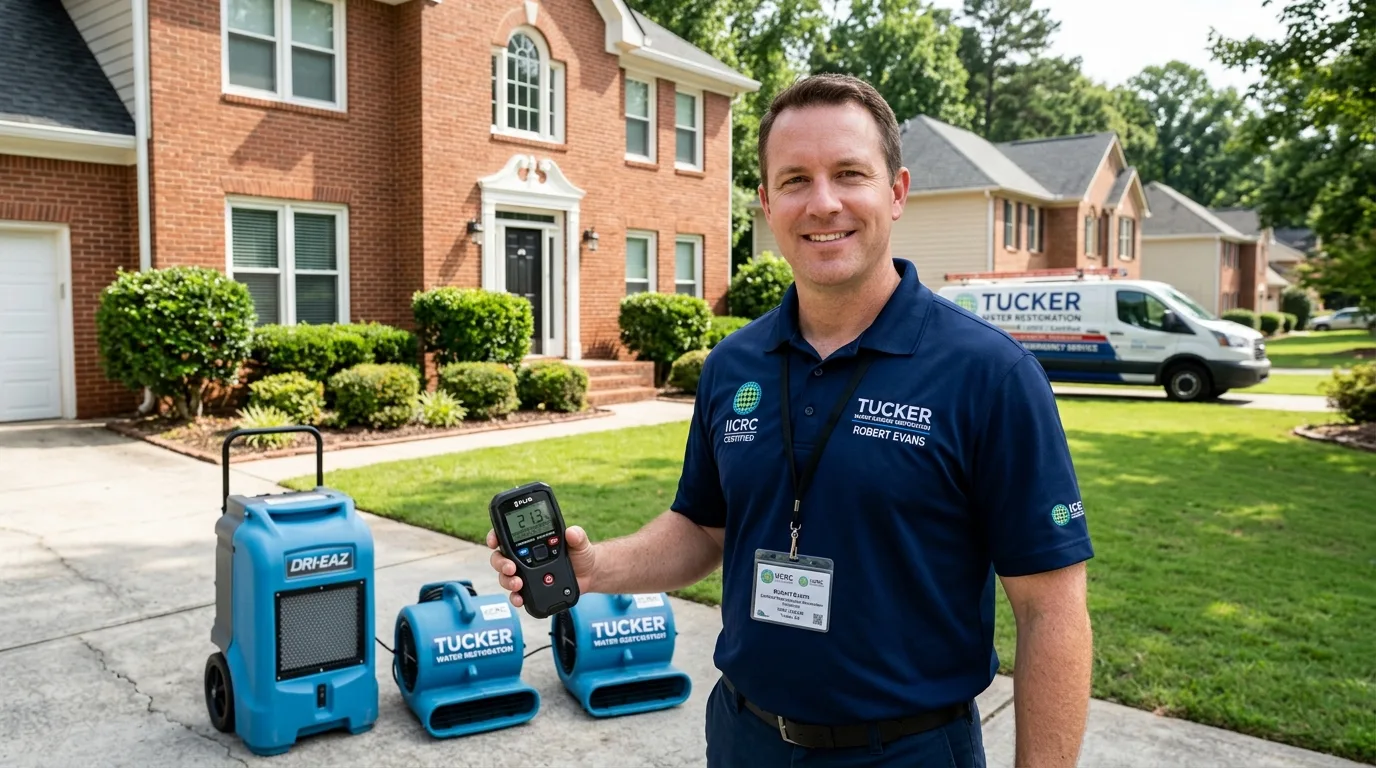
When water is flooding your Dunwoody home at midnight, you do not have the luxury of conducting a thorough vendor analysis. The company you call in those first minutes will have significant control over your insurance claim, your home’s structural integrity, and your family’s safety during the restoration process. Understanding what separates a qualified Dunwoody water damage restoration company from an unqualified one — before an emergency happens — is one of the most valuable preparations a homeowner can make. In this guide, we cover the credentials that matter, the questions to ask any company you call, and the red flags that should send you in a different direction.
Dunwoody's IICRC-Certified Restoration Team
Transparent credentials, full documentation, 24/7 availability. Call (877) 698-1311.
Why Dunwoody’s Market Requires Extra Diligence
Dunwoody’s high-value housing stock — with homes in neighborhoods like Heritage at Dunwoody and Hidden Branches regularly transacting above $1M — attracts both qualified restoration professionals and opportunistic contractors who appear in force after storm events. Following every significant summer storm in Dunwoody, door-to-door solicitation by storm-chasing companies increases dramatically. These companies may be licensed in another state, carry inadequate insurance, or use equipment that is insufficient for Dunwoody’s specific humidity and soil conditions.
The stakes in this market are high: a Dunwoody finished basement restoration can run $20,000+, and an insurance claim that is poorly documented will be underpaid. A restoration company that does not provide the moisture logs, scope documents, and thermal imaging evidence that DeKalb County adjusters require will cost you money on the claim and potentially leave you with recurring mold problems if the drying phase was inadequately executed.
Credential 1: IICRC Certification
The Institute of Inspection Cleaning and Restoration Certification (IICRC) is the defining credential in professional water damage restoration. Specifically:
WRT — Water Damage Restoration Technician: Certifies that the technician has been trained in moisture science, drying methodology, and water damage protocols. This is the baseline credential every technician working on your home should hold.
ASD — Applied Structural Drying: Advanced certification covering the science of drying structural assemblies — particularly relevant for Dunwoody basement and wall cavity jobs where standard drying benchmarks are inadequate.
AMRT — Applied Microbial Remediation Technician: Relevant if mold is present or anticipated — which in Dunwoody’s climate means most water damage events over 24 hours old.
Ask for certification numbers. IICRC certifications can be verified at iicrc.org. A company that cannot provide certification numbers or that claims “IICRC trained” (rather than certified) does not meet the standard.
Credential 2: Georgia Contractor Licensing
Georgia law O.C.G.A. 43-14 requires licensing for anyone contracting plumbing, electrical, HVAC, or certain structural work. If your water damage restoration involves any of these repairs — and it almost always does — verify that the company holds the appropriate Georgia contractor licenses, not just a business license. Ask specifically: “Are you licensed under Georgia O.C.G.A. 43-14 for plumbing and electrical work?”
Companies that do the mitigation (extraction, drying) and then subcontract reconstruction to unlicensed parties expose you to unpermitted work risk. A company that can handle the full scope from extraction through permitted reconstruction — with verifiable Georgia license numbers — provides a cleaner, more accountable process.
Fully Licensed in Georgia — IICRC Certified
Credentials you can verify. Call Dunwoody Water Damage Restoration at (877) 698-1311.
Questions to Ask Before Hiring
1. What IICRC certifications do your on-site technicians hold? — Not the company, the technicians who will be at your home. Ask for the names and certification numbers.
2. Are you licensed under Georgia O.C.G.A. 43-14 for plumbing and electrical work? — Required for full-scope restoration including reconstruction.
3. How do you size dehumidification for Dunwoody’s summer humidity conditions? — A company that can’t explain LGR vs. desiccant selection or psychrometric calculation does not have the technical depth to execute properly in this climate.
4. Will you provide daily moisture readings and a written scope of work? — These are what your insurance carrier requires. A company that won’t provide documentation is a claim problem waiting to happen.
5. How quickly can you dispatch to a Dunwoody address? — Rapid response matters. Via GA-400 and I-285, most of Dunwoody is reachable within 30–60 minutes from a well-located Atlanta metro operation.
6. How does your billing process work with insurance? — A company that requires full payment upfront and then expects you to recover from insurance is a different risk profile than one that works directly with your carrier.
7. Do you provide post-remediation clearance testing if mold is found? — In Dunwoody’s climate, mold is found more often than not during water damage events. Clearance testing confirms the space is safe before reconstruction.
Red Flags to Avoid
Door-to-door solicitation after a storm: Legitimate, established restoration companies do not go door to door after storm events. Storm-chasing companies that appear in Dunwoody after summer thunderstorms may be operating temporarily and may disappear before reconstruction is complete.
Pressure to sign immediately: Any company that requires you to sign a work authorization before they will tell you their credentials, provide a written scope, or allow you to contact your insurance carrier is not operating in good faith.
Estimates with no documentation: A written, itemized estimate is the professional standard. A verbal quote with no paper trail is a setup for scope disputes during the job.
“Certified” without verification: Ask for IICRC certification numbers and verify them at iicrc.org. “IICRC-affiliated” or “IICRC-trained” are not certifications.
Unwilling to coordinate with insurance: A restoration company that refuses to provide documentation in insurance-required format, or that discourages you from involving your insurance carrier, should be avoided.
Frequently Asked Questions
What’s the difference between remediation and restoration companies?
Remediation companies focus on the mitigation phase — extraction, drying, and mold removal. Restoration companies handle the full scope from mitigation through reconstruction. Some companies do both; some specialize in one or the other. For a complete water damage event, you want either a single full-service company or a coordinated two-company arrangement where the handoff between mitigation and reconstruction is smooth and documented.
Should I accept a restoration company recommended by my insurance carrier?
Insurance carrier networks often include qualified companies — but the carrier’s interest in controlling claim costs may not be perfectly aligned with your interest in getting the best restoration outcome for your Dunwoody property. You have the right to hire any qualified, licensed, IICRC-certified company. If you use a carrier-referred company, apply the same credential verification process described above.
How do I evaluate a restoration company if I’ve never had water damage?
Research before you need to, not during the emergency. Identify two or three IICRC-certified, Georgia-licensed restoration companies in Dunwoody or the North DeKalb area and save their numbers. Check Google and BBB reviews — particularly for how they handle insurance claims and whether finished jobs pass inspection. See our complete water damage restoration guide and our emergency extraction guide for more preparation frameworks.
Verified Credentials — Serving All of DeKalb County
IICRC certified, Georgia licensed, full documentation. Call Dunwoody Water Damage Restoration at (877) 698-1311.
Related resources: